
Mutoro Group Partners, LP
“I know it was tough, but you know, it happens. There are tough watches in any elite sport when you're trying to do something. On the whole, you don't get it all your own way from start to finish. Even the Invincibles—even the Invincibles—the last time Arsenal won the title, had a week from hell where it nearly all fell apart, where they went out of the Champions League, out of the FA Cup semi-finals, and were losing at half time to Liverpool. And then the miracle starts again, and it all ended up in the way that it did.
“Would you walk out of Macbeth before the last act, just moaning about the whole thing? ‘I don't care what happens next, it's just rubbish. Like who cares what happens to Macbeth or Lady Macbeth?’ Would you start the post-mortem on a guy whose heart is still beating? I just felt there was this huge wave of really, really toxic, ‘Let's just look at the negatives.’ And I think it's really important that Arsenal people cherish what is happening here that is positive. Because no one else is going to.”
— Amy Lawrence, Handbrake Off (April 16, 2026)
|
Annual % Change |
Compound % Change |
||||
|
MGP, LP (Gross) |
MGP, LP (Net) |
HFRI Fund Index |
MGP, LP (Gross) |
MGP, LP (Net) |
|
|
2015 |
(3.5%) |
(5.0%) |
(1.1%) |
(3.5%) |
(5.0%) |
|
2016 |
24.5% |
18.9% |
5.4% |
9.6% |
6.3% |
|
2017 |
(3.3%) |
(4.7%) |
8.6% |
5.1% |
2.5% |
|
2018 |
(0.9%) |
(2.4%) |
(4.7%) |
3.6% |
1.2% |
|
2019 |
30.0% |
23.9% |
10.4% |
8.4% |
5.4% |
|
2020 |
34.2% |
25.7% |
11.8% |
12.3% |
8.6% |
|
2021 |
8.5% |
5.5% |
10.2% |
11.8% |
8.1% |
|
2022 |
(44.8%) |
(45.7%) |
(4.3%) |
2.3% |
(0.8%) |
|
2023 |
21.6% |
19.9% |
8.1% |
4.3% |
1.3% |
|
2024 |
23.8% |
22.0% |
10.4% |
6.1% |
3.2% |
|
2025 |
5.6% |
4.0% |
12.7% |
6.1% |
3.3% |
|
Q1 2026 |
(8.6%) |
(8.9%) |
0.9% |
5.1% |
2.4% |
|
Aggregate |
74.8% |
29.9% |
90.3% |
||
|
Annualized |
5.1% |
2.4% |
5.9% |
||
Dear Partner,
For the first quarter of 2026, our fund declined 8.6 percent gross and 8.9 percent net of fees. We ended the period with ownership stakes in 14 companies. In April our portfolio rose 10.4 percent, back to essentially flat on the year.
When I was a student at Williams College in the spring of 2006, I took a classics course called Greek and Roman Drama. It was taught by David Porter, who was a renowned classicist, concert pianist, biographer of the writer Willa Cather, and the former president of both Carleton College and Skidmore College. A true Renaissance man. One day, unexpectedly, Professor Porter asked the entire class of twenty or so students if anyone wanted to define tragedy and comedy, two forms of storytelling which gained a lot of their modern shape in ancient Greece. This was a time before the pervasive access and existence of smartphones, laptops, and artificial intelligence, when you had to think live on your feet to participate in class and could not defer to a machine. He started looking immediately around the room, everyone sort of scratching their heads or staring into space to think up and offer a definition. After a few of my peers had their chance to define and contrast the two ideas, I raised my hand. Professor Porter loved my definition and suggested everyone write it down. I said, “In comedy, all the probability in the universe cheers. In tragedy, it weeps.”
(Note: I cannot take credit for the beautiful phrase, “All the probability in the universe cheers.” I originally read it in a different context in the remarkable short story titled How to Win from the writer Rosellen Brown. It is about a mother coming to terms with her difficult feelings around raising a child with undiagnosed mental illness. I adapted it to create my definition of tragedy and comedy.[1])
What I didn’t say in class, but was thinking about greatly in 2006, is that most of life is lived before probability has decided to cheer or weep, in the long middle where Patience is what holds you together and carries you to the final act.
Twenty years later, the first three months of 2026 presented fascinating dramas in equity markets. A broadly fascinating one in American and global events really. It gets so you might find yourself wishing for unfascinating and less dramatic times, if those ever existed. During the quarter, flipping through news stories each week of warfare, inflation, and state violence that seemed some mix of stupid, predictable, and avoidable, I found myself thinking a lot about Patience. Something I have long thought of. It has been a key word on the online landing page for The Mutoro Group for many years now, listed as a virtue I aspire to nurture, alongside Discipline and Rationality.
When I think of Patience, I like to think that there are, at least, four types: Waiting, Bracing, Hoping, and Enduring. I don’t mean to suggest that everything in life fits easily into these four or that experiences cannot slip from one category to another. Some things we encounter thinking they should be in one category of Patience, and when we find them in another unexpectedly, comedy or tragedy ensues.
To understand these four types, I think it’s useful to think about what Patience requires or delivers. When I do this, I come to two key variables, or sub-parts, of Patience: time and outcome. Time can be bounded or unbounded, and the outcome can be certain or uncertain. I didn’t use to think of it visually but in trying to figure out how to share this idea with you, a graphic came to mind, so I’ll share it here. Imagine if you will a two-by-two grid. See chart below. Let’s go clockwise from the top left.
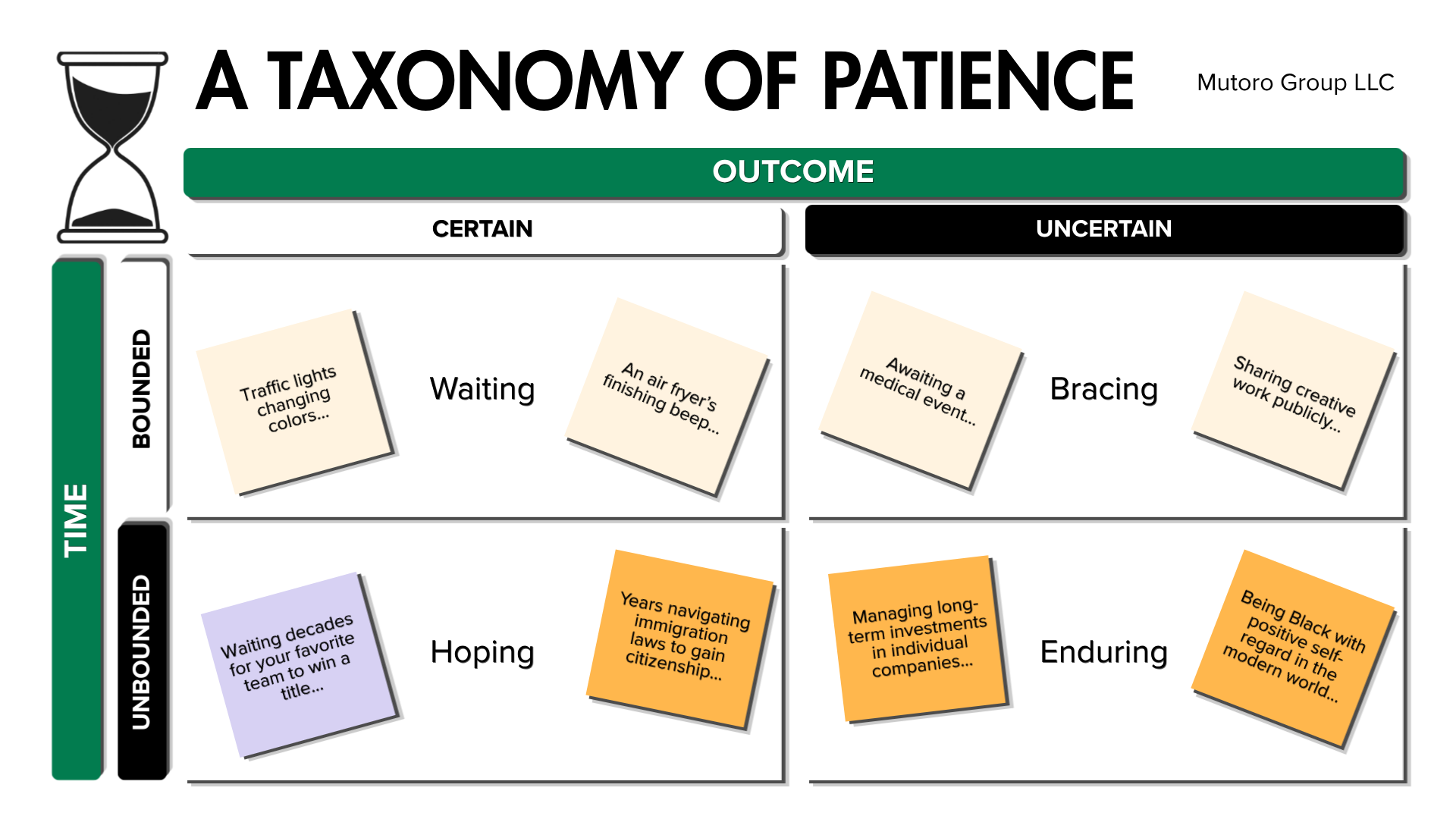
The first type of Patience, Waiting, is the sort of everyday one we encounter in our modern lives. It’s bounded on the time axis, and the outcome is (usually) certain. Examples of this could be standing by expecting the visibly timed finish of an air fryer in your kitchen or being out on the road waiting for the unseen clock of a traffic signal to change colors. Getting through these sorts of moments requires the basic skills of delayed gratification, self-control, and executive function that families and healthy communities try to instill in their members, with effects that can last a lifetime, positively or negatively.
The second type of Patience, Bracing, is bounded on the time axis but the outcome is uncertain, to varying levels. An example could be the period between a medical event and receiving a diagnosis, test result, or treatment. Or in less corporeal matters, perhaps sharing a creative work publicly, knowing that engagement itself is unpromised, and that if feedback does come, you cannot know in advance what shape it will take.
These first two, Waiting and Bracing, affect all humans irrespective of background, identity, and social status. That we all encounter these is a function of the random ways in which the same events happen to everyone at different stages of life. One person’s red light is another’s green light. One person’s romantic mistake is another’s cherished partner. One person’s adolescent health scare is another’s terminal diagnosis in old age.
One tactic I figured out long ago for managing uncertain outcomes was to prepare myself in advance through mentally sorting the range of results into three possible buckets: Favorable, Neutral, and Unfavorable. And this would help ringfence my imagination and anticipation, even knowing the result could still run wild within those three enclosures. It has helped me a great deal. That said, just as in George Orwell’s Animal Farm, where “All animals are equal, but some are more equal than others,” it is also true that all favorable outcomes are favorable, but some are more favorable than others. The same applies for Neutral and Unfavorable outcomes.
When in life we meet these experiences and how we handle them both shape and reveal personality. The next two types of Patience, Hoping and Enduring, speak more to our character and chance. I say this in that we have some agency in deciding to enter them. But often we find their duration and results can be out of our control.
In Hoping, the time axis is unbounded but the outcome is (often) certain in shape, if not in occurrence. Examples include stomaching years of your favorite sports team going through losing seasons before it wins a title. I understand this well. Firstly, as a fan of the National Basketball Association’s Boston Celtics who first saw them win a trophy in 2008, 22 years after their prior title, and then again 16 years later in 2024. And secondly as a die-hard supporter of the English Premier League’s Arsenal Football Club, a fandom my older brother George passionately held and introduced me to, which, as I write this, is fighting for its first league title in 22 years and its first Champions League trophy ever. And I also understand Hoping even more intimately from my own life’s efforts. I immigrated to America in 1988 and spent 18 years navigating with my family the country’s byzantine immigration policies before becoming a Permanent Resident in 2006. Before receiving my green card, I knew how challenging it can be to live a second-class life as a foreigner in the only country you have ever really known, being forced, because of my conditional visa status, to pass up any number of jobs, travel, and educational opportunities. Six years later, in 2012, I became a Naturalized U.S. Citizen. Before that date, traveling internationally on my Kenyan passport meant that countries I sought to enter required, months in advance and at formal embassy meetings, thick portfolios containing all of my bank records, proof of income, and notarized statements that I would not stay beyond my welcome. Writing this now from Norway, I can say that with an American passport the world opened to me; I could just breeze through immigration (usually). A piece of paper with my name on it changed my status but the psychological melding I went through stuck, keeping me fiercely independent and skeptical of institutions.
The fourth type of Patience is what I call Enduring. One might think the prior examples in Hoping would fit here, but I think they do not, because in Hoping the shape of the result is known even if its arrival is not. Either your team wins the trophy, or it doesn't. Either you become a citizen, or you don't. The outcome's form is clear; its occurrence isn't. In Enduring, both the time to wait and the very shape of the outcome are uncertain. A relevant example from my own life: managing The Mutoro Group, where we make long-term equity investments in individual companies. It is a fascinating drama, especially our portfolio as currently constructed with six of our 14 holdings, or 32.2 percent of our assets at quarter end, being turnaround situations priced, in my view, at pennies on the dollar since the 2022 market dislocation. These present false summits, false valleys, and require study and stamina. You have negligible say in managerial decisions and the macro economy. What you do control is your attention and temperament. What is paramount is how you decide to weigh information en route to an outcome (e.g., a market price close to intrinsic value) that might never really come or might always be slightly out of reach. For many people this would be a nightmare. I find it intellectually stimulating, challenging, and rewarding.
The worlds of religion and philosophy have a lot to say about Patience, though there has not been a lot of academic work on the topic. I was admittedly impatient to put my own thoughts on paper, so I wrote this before exploring the literature. Baylor University professor Sarah Schnitker has, since 2012, been a leading researcher on patience, self-control, and gratitude, virtues she studies through what she calls her Science of Virtues lab. Unlike me, she identifies three types of Patience: Daily Hassles, Interpersonal, and Life Hardships. She makes the excellent point that while the capacity for Patience is always a virtue, its application is not always. Sometimes courage, action in the face of fear, is more important. In a recent interview she said:
An example I love to give is, let’s say, working against sexism in the workplace, for instance, right? As a woman, sometimes I encounter a situation that involves sexism and sometimes the wise thing to do is to speak up, to pull upon my courage as a virtue in that capacity and to do something. Other times, it’s not the right moment and actually being quiet and just remaining calm in this moment is the right thing to do. And I need my patience to help me do that and understanding—like if my goal is to create an equitable, inclusive workplace, then I need to have both patience and courage to get me there, and that way I can navigate situations well and not just be driven by my anger or by my fear—that I have the capacity to regulate my emotions in a productive manner for the good of myself and others.[2]
The table below shows the composition of our portfolio at the end of the quarter.
Portfolio Holdings
Thank you for your capital, your partnership, and your Patience. I am available to speak with you and with anyone you know who might be interested in joining us.
Sincerely,
Godfrey M. Bakuli
Founder & Managing Partner
[1] Brown, Rosellen. “How to Win.” The Massachusetts Review 14, no. 4 (1973): 691–706. https://www.jstor.org/stable/25088361
[2] American Psychological Association. "How to become more patient, with Sarah Schnitker, PhD | Speaking of Psychology." YouTube video. March 11, 2026. https://www.youtube.com/watch?v=6RB6ReKbgPM